Lightning on Mars? What the Surprising New Discovery Could Mean for the Red Planet

Have scientists just detected lightning on Mars? Discover what it could mean for Martian weather, future missions, and our understanding of the Red Planet!
For more than a century, Mars has captured human imagination as a place of mystery – a dusty world that feels both completely alien yet strangely familiar at the same time. It’s a planet of dramatic landscapes, swirling ochre storms, towering volcanoes, deep canyons, and frozen polar caps that hint at a wetter past. But in recent decades, we’ve grown used to thinking of Mars as a fairly quiet place. Dry. Cold. Predictable. Not exactly the kind of world where you’d expect dramatic flashes tearing through the sky.
So when scientists recently suggested that Mars may experience lightning after all, it caused a noticeable buzz in the astronomy community. After all, lightning isn’t just a flashy spectacle. It’s a clue. It adds a whole new layer to how we understand a planet’s atmosphere, weather patterns, chemical processes, and even its habitability.
Could Mars really crackle with electricity? Could dust storms – already known to wrap the entire planet in swirling clouds – also generate thunderous bursts of static discharge? And if so, what does that mean for future Mars missions, crewed exploration, and our picture of the planet’s past?
Let’s break down what scientists think they’ve discovered, why it’s causing such excitement, and what it could reveal about the Red Planet’s surprisingly dramatic weather.
Could There Really Be Lightning on Mars?
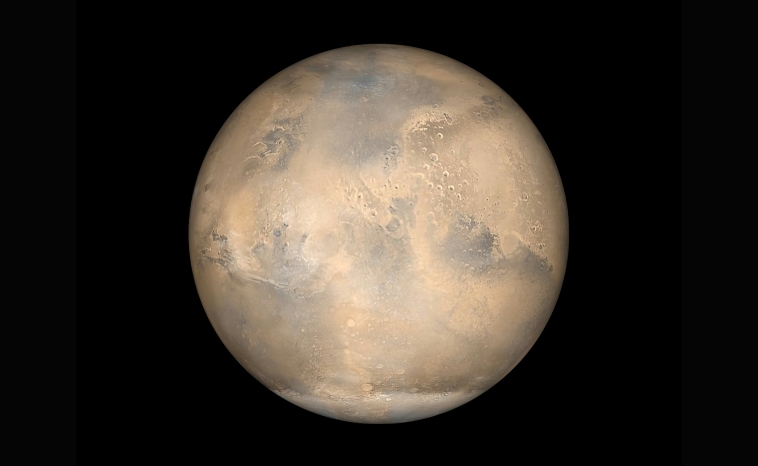
The recent findings that sparked all the excitement come from instruments sensitive to radio waves – the kind of signals produced when lightning bolts discharge electricity into the atmosphere. On Earth, these signals are easy to recognise: they radiate outward in distinct pulses. When researchers noticed similar pulses coming from inside Martian dust storms, their eyebrows understandably rose.
Mars is known for its dust storms – in fact, it’s famous for them. Some are so massive that they envelop the entire planet, shrouding the surface in haze for weeks or even months. These storms are made of tiny, fine dust particles that can remain suspended for a very long time. They’re dramatic, but few expected them to produce actual lightning.
For decades, scientists assumed that Mars simply didn’t have enough atmospheric density to generate the electrical charge needed for lightning. Compared to Earth, Mars has just 0.6% of our atmospheric pressure. And with almost no moisture, few clouds, and thin air, the idea of lightning seemed far-fetched.
Yet this new data is compelling. The radio signatures look uncannily like those produced by electrical discharges on Earth. They’re short, sharp, and intense – and they appear to originate from within the turbulent heart of Martian dust storms.
Is it definitely lightning? Not quite. The evidence is strong, but not conclusive. It’s possible that Mars has a form of “dry lightning” – more static in nature than Earth’s water-driven storms. But whatever it is, it’s electrical. And that alone is fascinating!
What Causes Lightning – And Could Those Conditions Exist on Mars?
To understand why lightning on Mars is surprising, it helps to understand what causes lightning on Earth.
How Lightning Forms on Earth
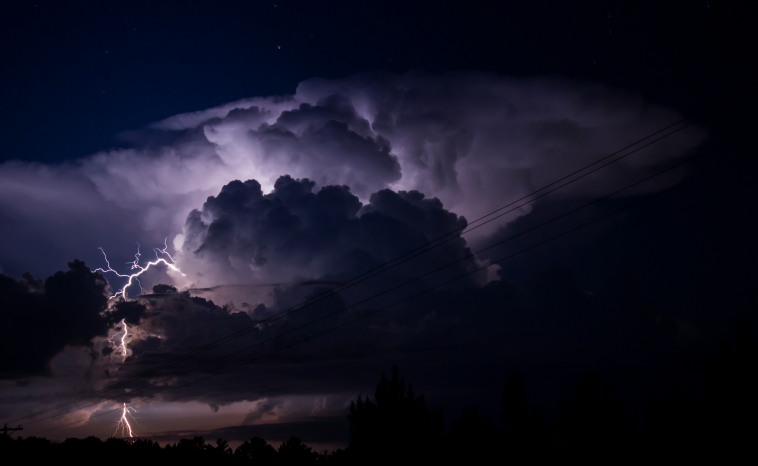
Earth’s lightning mostly comes from storm clouds full of ice crystals and water droplets. As these particles collide, they exchange electrical charges. Over time, charge builds up, separating into regions of positive and negative energy. When the charge imbalance becomes too great, it discharges as lightning – either within clouds, between clouds, or between the clouds and the ground.
All of this depends on a fairly dense atmosphere full of moisture. Mars, however, has:
- Hardly any water in its atmosphere
- Very little cloud cover
- Extremely thin air
- Cold temperatures
So how can lightning form in such different conditions?
Dust Instead of Water: Mars’ Unique Mechanism
The leading theory is that Martian lightning is created by dust, not water or ice.
When tiny dust grains collide in the swirling chaos of a storm, they can exchange charge in much the same way as particles in an Earth storm. This process is called triboelectric charging – you might have experienced the same thing on Earth when rubbing a balloon on your jumper!
During a Mars dust storm, dust grains are lifted kilometres into the air, where they collide countless times, generating static electricity. With enough friction and enough dust, static charge can build into an electrical field strong enough to discharge.
These electrical discharges may not look exactly like Earth’s lightning – possibly fainter, shorter, or lower in energy – but they could still count as a form of lightning.
Why Lightning on Mars Would Be a Big Deal
Lightning on Mars isn’t just a fun headline. If confirmed, it would reshape a surprising number of scientific fields – from planetary weather to astrobiology to human spaceflight.
Here’s why that little spark matters so much.
1. It Reveals Hidden Complexity in the Martian Atmosphere
Mars has long been considered a planet with relatively simple weather: cold, dusty, windy, but not especially dynamic. Lightning would challenge that view completely. It would show that Mars has:
- Active electrical processes
- Energy transfers in storms
- Conditions capable of generating strong atmospheric charge
This means the planet’s weather is more complex – and more Earth-like – than we previously believed.
2. It Helps Us Understand Mars’ Past Climate
One of the big mysteries of Mars is what its atmosphere was like billions of years ago, when water flowed on the surface. Scientists believe Mars once had a thicker atmosphere and a warmer climate. If modern storms can generate lightning even with the current thin atmosphere, the ancient atmosphere may have had enough density to produce strong, frequent lightning.
Lightning is important for another reason: on early Earth, lightning played a potential role in creating the building blocks of life. We don’t know if that was also true on Mars, but this discovery opens the door to new hypotheses.
3. It Has Implications for Human Exploration
Future astronauts on Mars will have to contend with dust storms – and electrical activity could complicate things further.
- Electrical discharges can affect:
- Communications systems
- Solar panels
- Electronic equipment
- Habitat safety
- Dust adhesion on spacesuits
Understanding how Martian lightning works will be essential for designing future missions. Engineers will need to know whether dust storms pose an electrical hazard and how strong these discharges may be.
4. It Helps Us Predict Storm Behaviour
On Mars, storms behave differently from Earth’s. Some begin as small whirlwinds, grow into regional storms, and sometimes expand to engulf the entire planet. If electrical activity is present, it could help scientists monitor and predict these storms with greater accuracy – essential for the safety of rovers, orbiters, and future astronauts.
Could There Be Thunder on Mars?
With lightning comes thunder… right?
Not necessarily.
Thunder is the sound of air rapidly expanding after being superheated by a lightning bolt. But sound behaves very differently in the thin Martian atmosphere.
Given the low air pressure, thunder on Mars (if it exists at all) would likely be:
- Extremely faint
- Low in frequency
- Muffled beyond recognition
- Audible only within a short distance
In other words, you probably wouldn’t get dramatic, Earth-like cracks of thunder rolling across the Martian plains. Instead, any thunder would be subtle – more like a soft pop or rumble.
Still, it’s an intriguing idea: the quiet Red Planet may not be quite so quiet after all!
What Scientists Need to Confirm Next
The evidence is exciting, but it’s still not a definitive “yes.” So what needs to happen next before the scientific community can say for sure that Mars has lightning?
More Radio Observations
The current data is promising, but researchers need more radio measurements from different storms, different locations, and different seasons to confirm the pattern.
Orbital Confirmation
Orbiters around Mars – such as MAVEN, Mars Express, and the Trace Gas Orbiter – may be able to observe complementary signals. If two or more instruments detect the same event, confidence will rise significantly.
Visual Proof
Lightning flashes could potentially be captured in images, though they are likely faint. Cameras would need to be pointed at storms during active periods, ideally in low light.
Measurements From the Surface
Future Mars rovers or landers could be equipped with:
- Electric field detectors
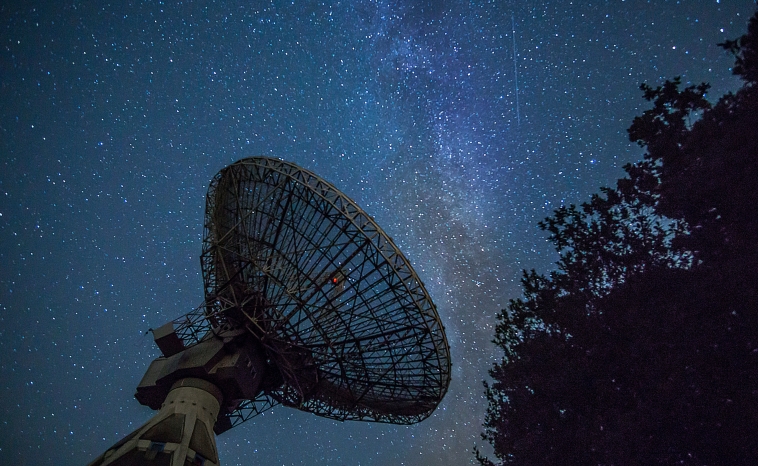
- Ground-based radio antennas
- Dust charge sensors
- Atmospheric ion probes
A single lightning strike detected on the surface could confirm everything.
Laboratory Simulations
Scientists also simulate Martian dust storms in vacuum chambers on Earth. If they can reproduce lightning-like electrical discharges under Mars-like conditions, that would strongly support the theory.
Explore the Universe From Home

Mars may still be full of surprises, but that’s what makes space exploration so captivating. Every discovery sparks new questions, challenges old assumptions, and reminds us that even familiar worlds can still hold mysteries waiting to be uncovered.
Even if Mars is still keeping some of its secrets hidden, you don’t need a spacecraft or a rover to explore the Red Planet yourself. With a clear sky and a little practice, Mars is easy to spot from Earth – especially when it shines brightly during opposition.
If you’re inspired by mysteries like Martian lightning, OSR’s tools can help you dive deeper into the night sky. With the OSR Star Finder App, personalised star maps, and detailed guides to the constellations, you can explore the cosmos from your own home.
And if you want to share that sense of wonder with someone special, naming a star through OSR is a beautiful way to celebrate their curiosity and connection to the universe. Whether you choose the Online Star Gift, the OSR Gift Pack, or the Super Star Gift, each option offers a unique way to bring the magic of the night sky just a little closer.