Will 2024 YR4 Hit the Moon – and What Happens if it Does?
Could asteroid 2024 YR4 really hit the Moon? Learn what scientists predict, the potential effects, and what it means for Earth and future space exploration.
In July 2025, astronomers around the world were watching an object known as 2024 YR4, a near-Earth asteroid that briefly made headlines when new calculations suggested it could potentially collide with the Moon in 2032. Although the odds of such an impact remain very small, the possibility has sparked curiosity and raised questions about what would happen if it did. Would the Moon be significantly altered? Could Earth feel any effects? And why does tracking such objects matter? Let’s take a closer look!
What Is 2024 YR4?
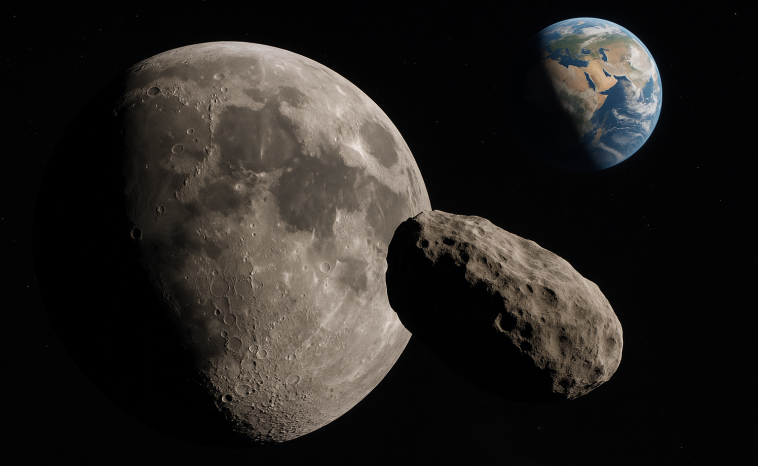
2024 YR4 is an asteroid discovered in late 2024 and classified as a near-Earth object (NEO). These objects orbit the Sun but come close to Earth’s orbit, sometimes posing a potential hazard. Astronomers estimate that 2024 YR4 is roughly 250–300 metres across – smaller than the asteroid thought to have wiped out the dinosaurs, but certainly large enough to cause significant effects if it struck a planetary surface.
Most NEOs like 2024 YR4 are tracked carefully using powerful telescopes and radar observations. These allow astronomers to calculate their orbits and predict whether they will pose any future danger. In this case, updated observations in 2025 slightly increased the chance that 2024 YR4 could intersect with the Moon’s orbit in about seven years’ time.
How Likely Is an Impact?
At present, NASA and other space agencies estimate there is a roughly 4% chance of 2024 YR4 colliding with the Moon in 2032. That might sound like a pretty small chance, but it’s significant enough for plenty of astronomers to keep paying close attention! In most cases, further observations reduce the level of risk as the orbit becomes better understood. But for now, a lunar impact remains a possibility.
The chances of 2024 YR4 colliding with Earth are far lower. Current models suggest the asteroid’s path will not cross our planet directly, so there’s no immediate danger to humanity. Still, because the Moon orbits close to us, any interaction with it naturally raises interest and concern.
What Would Happen If 2024 YR4 Hit the Moon?
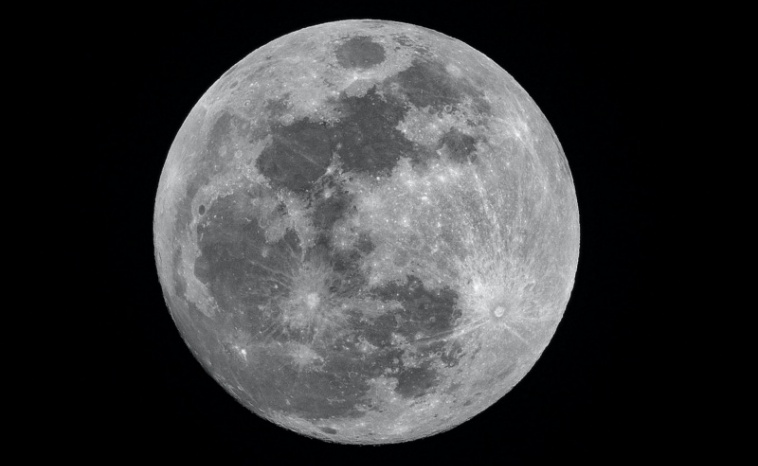

If the asteroid were to collide with the Moon, the results would be dramatic on a local scale. Scientists predict that:
- A large crater would form: Given its size, 2024 YR4 could carve out a new lunar crater several kilometres wide. This would join the Moon’s vast collection of craters created by billions of years of impacts.
- Debris would scatter into space: Material ejected from the impact could escape the Moon’s weak gravity, creating a temporary cloud of dust and fragments. Some of these might even drift into Earth’s atmosphere, appearing as small meteors.
- No major effect on Earth: Despite the drama, Earth would remain largely unaffected. The Moon is large and stable, and even a sizeable asteroid impact would not knock it off orbit or cause catastrophic changes to tides.
- Scientific opportunity: If such an impact did occur, it would offer scientists a rare opportunity to study the process of crater formation in real time. Spacecraft orbiting the Moon, like NASA’s Lunar Reconnaissance Orbiter, could observe the event and help refine our understanding of impacts.
Could the Impact Affect Life on Earth?
The good news is that Earth would not experience any direct harm from such an event. The Moon’s orbit is stable, and the gravitational relationship between Earth and Moon is robust. While some small debris could theoretically drift toward Earth, most would burn up harmlessly in our atmosphere.
However, there could be indirect consequences. For instance, satellites orbiting Earth or the Moon might need to avoid debris fields if fragments were ejected into space. The event could also temporarily alter the reflectivity of the Moon’s surface, which might be noticeable to astronomers observing from Earth.
Why Tracking Asteroids Matters
Although the risk to Earth from 2024 YR4 is low, the story highlights the importance of monitoring asteroids. Planetary defence has become a serious area of research, with dedicated teams at NASA, the European Space Agency, and other organisations scanning the skies for potential hazards. By tracking objects like 2024 YR4, scientists can give early warnings of potential impacts and even plan future missions to deflect them if necessary.
In 2022, NASA successfully tested such a concept with the DART mission, which deliberately impacted a small asteroid moonlet and altered its orbit. This proof of principle shows that humanity could, in theory, prevent a dangerous asteroid from colliding with Earth in the future.
Lessons From the Past
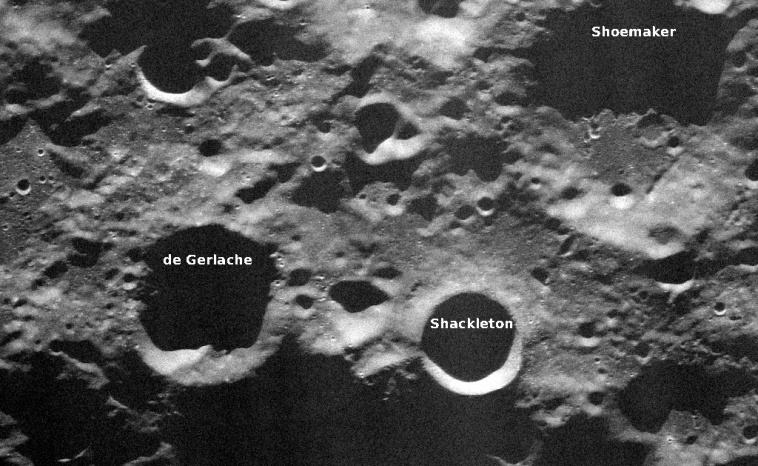
JeanLucMargot, CC BY-SA 3.0, via Wikimedia Commons
JeanLucMargot, CC BY-SA 3.0, via Wikimedia Commons
The Solar System is filled with evidence of impacts. Impact craters have scarred the Moon’s surface, each one a reminder of collisions stretching back billions of years. On Earth, too, we see the results in places like the Chicxulub crater in Mexico, linked to the extinction of the dinosaurs 66 million years ago. While impacts of that scale are thankfully rare, they demonstrate why astronomers treat NEOs so seriously.
Smaller impacts happen more often, though most go unnoticed because they occur in remote areas or over the ocean. A notable example was the Chelyabinsk event in 2013, when a 20-metre asteroid exploded in the atmosphere over Russia, injuring over 1,000 people due to the shockwave. Compared to that, 2024 YR4 is much larger, underlining why astronomers pay close attention even when the target is the Moon rather than Earth.
What Happens Next With 2024 YR4?
Over the coming years, astronomers will continue to track 2024 YR4’s path. As we collect more data, the predicted orbit will become clearer, and the chance of a lunar impact in 2032 may rise or fall. If the asteroid does look likely to collide with the Moon, it could become one of the most anticipated astronomical events of the decade. Telescopes worldwide would watch closely, and the public would no doubt be fascinated by the prospect of seeing a new lunar crater form.
For now, though, 2024 YR4 remains just one of many near-Earth objects under observation. The vast majority pose no threat, but studying them deepens our understanding of the Solar System and helps us prepare for the rare occasions when one might come too close.
Making the Cosmos Personal

While we can’t control asteroids, we can connect with the stars in our own way. Through the Online Star Register, you can name a star for someone special, creating a unique and lasting connection with the sky above. It’s a way to turn curiosity about the universe into something personal and meaningful!